

Bilateral diplomatic relations between the Republic of Ghana and the Russian Federation, then known as the Soviet Union, officially began in January 1958, shortly after Ghana gained its independence. The relationship between the two countries witnessed a dynamic growth under Ghana’s first president, Osagyefo Dr. Kwame Nkrumah from 1957 to 1966.
Ghana and Russia have maintained friendly diplomatic ties over the years and in recent years made a giant step to expand economic relations, characterized by growing trade volumes; surpassing hundreds of millions of dollars and active cooperation in varies sectors, from energy, agriculture, education to inter-parliamentary dialogue.
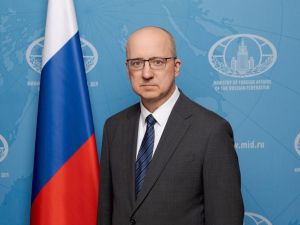
Ahead of the much anticipated third edition of the annual Russia-Africa Summit scheduled to take place in October 2026 in Moscow, I was privileged to be hosted by the His Excellency Andrei Ordash, Ambassador Extraordinary and Plenipotentiary of the Russian Federation to the Republic of Ghana for a conversation on Ghana – Rusia bilateral relations.
Question: How will you describe your time in Ghana?
Answer: It has only been a very short time since my arrival, but I can already say that I feel very much at home here. My appointment as Ambassador was made by a Decree of the President of Russia in March this year. In June, I presented my credentials to the President of Ghana, H.E John Dramani Mahama, which marked the official start of my duties. My strongest impression is the Ghanaian side’s sincere willingness to deepen our cooperation.
My initial meetings with Ghana’s leadership have been extremely positive and confirm that Ghana is a reliable and promising partner for Russia in West Africa. We see Ghana’s commitment to pursuing a pragmatic, multi-vector policy and to strengthening ties with our country. I am also optimistic about the economic situation in Ghana: the country is demonstrating impressive macroeconomic stability, and we are seeing a marked increase in mutual interest. Therefore, to answer your question, I would say that things are going very well, and we are fully determined to take the Russian-Ghanaian partnership to a whole new level.
Question: What do you seek to achieve with as Ambassador to Ghana?
Answer: This appointment is undoubtedly a landmark event for me, and I regard it as a tremendous honour and a great responsibility. For Russia, Ghana is a key and reliable partner in West Africa. It is a country with enormous potential, demonstrating impressive economic growth – it is already one of the continent’s eight largest economies. It is a great honour for me to represent Russia’s interests here at this very moment, as our relations are entering a qualitatively new phase. The figures speak for themselves: our trade turnover has grown from 247 million dollars in 2022 to more than 800 million in 2024. These are not merely statistics; they are evidence of mutual interest and enormous untapped potential. I see my key task as making the most of this momentum.
We are focusing on specific projects in the energy sector, agriculture and the mining industry. We don’t want to just trade, but to set up joint ventures, transfer technology and contribute to Ghana’s industrialisation. In this context, Ghana, as the host country of the secretariat of the African Continental Free Trade Area (AfCFTA), serves as a gateway to the vast African market. Furthermore, we are bound by strong historical ties, and today we are actively working to expand our humanitarian presence. So, for me, this appointment is an opportunity to draw on my previous experience to build a modern, pragmatic and mutually beneficial partnership with one of the continent’s most dynamically developing countries.
Question: What are the areas of focus for the Embassy?
Answer: My mission is focused on one main objective – to take our partnership to a qualitatively new, practical level that will serve the interests of the peoples of both countries. I see the main areas of activity as follows. Firstly, deepening political dialogue. Ghana pursues a pragmatic and multi-vector foreign policy. We intend to take our political contacts to a qualitatively new level, including coordination at the United Nations (UN) and other international forums. Here, our positions are aligned: we advocate a just world order. A striking example is the recent vote on UN Resolution 80/250, where Ghana took the initiative to recognise the slave trade as a crime against humanity. Russia did not only voted ‘in favour’, but also became one of the most active supporters of this document.
Secondly, there are specific sectors of the economy where we see enormous and untapped potential. The Intergovernmental Agreement on Cooperation in the Field of Peaceful Uses of Atomic Energy was signed in 2015, laying the foundations for the future construction of a nuclear power station. This could make a long-term contribution to Ghana’s energy security and industrialisation. We are ready to offer Ghana a partnership in the fields of artificial intelligence, cyber security, independent payment systems and digital governance.
Thirdly, there is human capital. Education remains a key component. For the coming academic year, the quota for Ghanaian students stands at 120 places, and there are already more than 600 Ghanaian citizens studying in Russia. These are our future specialists and the bridges of friendship between our countries. My task is to ensure that we have a clear action plan for the years ahead.
Question: Ghana’s economy is largely driven by agriculture, are there planned initiatives to help develop the sector?
Answer: Agriculture is a key sector of Ghana’s economy, and we see enormous potential to help Ghana address the challenges if faces in the sector. We are prepared to go beyond simply supplying grain and fertilisers. This could involve establishing agro-industrial facilities directly on Ghanaian soil to localise production. Ghana has shown great interest in joint projects with Russian research centres in the field of agriculture. Should the Ghanaian leadership express an interest, we are ready to help Ghana become a key player in ensuring food security for the entire region.
Question: Will are going to introduce programmes to enhance the trade volume between Ghana and Russia?
Answer: Increasing trade turnover and creating effective platforms for business interaction are among our key priorities. We take a comprehensive approach to this, establishing practical mechanisms for direct contact between entrepreneurs. As already noted, trade between our countries has more than tripled in recent years. This growth is the best evidence of our mutual interest, and we intend not only to maintain but also to significantly build on this result. We have key government mechanisms in place to ensure systematic progress. The most important of these is the Russian–Ghanaian Intergovernmental Commission on Trade, Economic, Scientific and Technical Cooperation. Regular meetings at this level enable us to remove systemic barriers and set strategic directions.
We are creating conditions for businesses to operate directly, without intermediaries. Ghanaian businesses are actively involved in major events in Russia. In this context, a key recent event was the 17th International Economic Forum ‘Russia – the Islamic World: KazanForum’, which took place in Kazan from 12 to 17 May 2026. On the sidelines of the forum, a ‘Russia–Ghana’ round table was held, organised by the Ghana–Russia Centre for Trade and Relations. A key event that will give fresh impetus to all these processes will be the Third Russia–Africa Summit, scheduled for 28–29 October 2026 in Moscow. We expect it to provide a powerful boost to our trade and economic ties.
Question: Can you share light on some key Russian investments in Ghana and way forward?
Answer: Ghana, with its political stability and rapidly growing economy, is becoming increasingly attractive to Russian businesses. The growth in trade is creating a solid foundation for the transition to long-term projects. In the energy sector, as I have already noted, we are ready to begin substantive discussions on the construction of a nuclear power station in Ghana using Russian technology. In industry and processing, we are focused on creating added value locally. Russian companies are already active in the upstream sector: Lukoil ыешдд holds a 38% stake in the Deepwater Tano Cape Three Points offshore block development project (the Pecan field).
Question: What is Russia’s approach to aid in sustaining the peace and security in the West African sub-region?
Answer: Ensuring peace and stability, particularly in light of the complex situation in the Sahel, is one of the key themes of our dialogue with Ghana and other African partners. For Russia, countering terrorism in all its forms is an absolute priority. We view the threat emanating from the Sahel not as a local issue, but as a problem affecting the security of the entire continent, including coastal states such as Ghana. That is precisely why this issue was a key topic at the recent ministerial conference between Russia and the Confederation of Sahel States (CSS), which comprises Burkina Faso, Mali and Niger. During that meeting, we agreed to work actively to identify and disrupt the channels of terrorist financing. Our cooperation with the CSG in this area is systematic and practical in nature.
Security issues also feature prominently in our bilateral relations with Ghana. We highly value Accra’s pragmatic and balanced approach to the region’s challenges. During the political consultations held in March 2026, delegations from our countries held a thorough exchange of views on regional security, paying particular attention to developments in the Sahel. We fully share Ghana’s concerns regarding the spread of instability and support its efforts to strengthen national security.
Russia has consistently advocated for the strengthening of international security and the non-proliferation regime. Our position on these issues forms part of our consistent approach to shaping a more just and stable world order. We remain committed to our obligations in this area and believe that the key to global stability lies in honest and equal dialogue, free from double standards. We reaffirm our readiness to continue contributing to the maintenance of peace and security in West Africa, acting in a spirit of partnership and with full respect for the sovereignty of the states in the region.
Question: Are there special initiatives and exchange programmes targeting young people and women specifically?
Answer: There is no doubt that people-to-people contacts form the very foundation upon which any strong and trusting inter-state relations are built. We in Russia understand this perfectly well, which is why we pay the utmost attention to the development of humanitarian ties, educational and cultural exchanges.
Educational cooperation has been, and remains, the flagship of our humanitarian relations. Thousands of Ghanaian citizens who were educated in the Soviet Union and Russia constitute the very ‘living link’ that unites our peoples. This is the solid foundation upon which we are building our future. And this tradition is not only being preserved but is also actively developing. Ghana ranks among the leading African countries in terms of the number of applications for admission to Russian higher education institutions.
We are establishing systematic cooperation between universities in both countries. The first Ghanaian university to join the Russian-African Network University was the Takoradi Technical University (TTU) – this opens up new opportunities for exchange programmes, joint research and summer schools. Bilateral partnerships are actively developing between a number of Russian and Ghanaian universities: Kuban State Agrarian University (cooperation in the field of agricultural education and innovative technologies), Northern (Arctic) Federal University (SAFU), Yaroslavl State Pedagogical University, Volgograd State Agrarian University, Novosibirsk State Technical University and Tomsk State University.
Our focus is on training highly qualified professionals, and we see great potential for women’s participation in this area. We place emphasis on training specialists who will be in demand in Ghana – engineers, agronomists and media professionals. A memorandum of understanding has been signed between the Sputnik news agency and UniMAC to develop educational programmes for journalism students. Russian scholarships and educational programmes are open to all Ghanaian citizens, including women and young people, on an equal footing. Our aim is for every Ghanaian student who has visited Russia, and everyone who is learning Russian, to become an ambassador of goodwill, strengthening our long-standing friendship.
Question: Your final words as we wrap up this interview, Your Excellency.
Answer: To conclude our conversation, I would like to thank you for this in-depth dialogue and for giving me the opportunity to address the Ghanaian audience directly. Relations between Russia and Ghana are currently experiencing a veritable renaissance. We view Ghana not merely as a trading partner, but as a reliable ally in building a just, multipolar world. I would like to reaffirm once again that Russia is a reliable and predictable partner for Ghana. My personal mission as Ambassador is to ensure that our ties grow stronger with each passing day, so that together we can overcome challenges and make the most of the opportunities that arise. Thank you for your attention and interest in Russian-Ghanaian relations. I wish the brotherly people of Ghana prosperity and well-being!